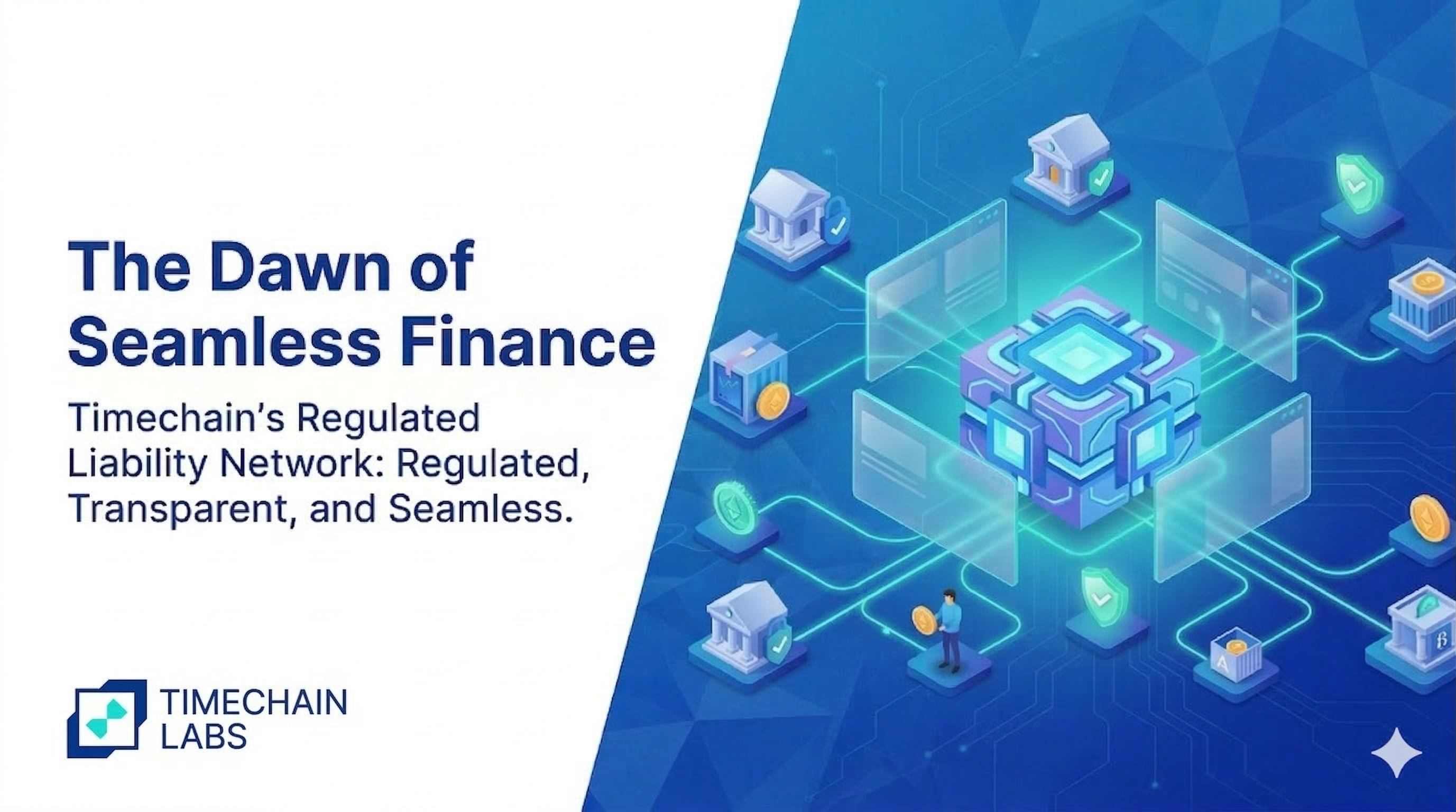



The Dawn of Seamless Finance
For decades, the global financial system has operated on a patchwork of siloed databases, fragmented messaging systems, and delayed settlement processes. Moving value across borders—or even between different regulated institutions—has historically required a complex web of intermediaries, leading to friction, high costs, and counterparty risk.
But the financial internet (or "finternet") is evolving. Enter the Timechain Regulated Liability Network (RLN)—a groundbreaking launch that is positioned to be the fastest, most scalable unified ledger solution for financial institutions to leverage today.
Here is a deep dive into what the Timechain RLN is, why speed is its ultimate superpower, and how it is set to redefine the future of institutional finance.
What is a Regulated Liability Network (RLN)?
To understand the magnitude of this launch, we first need to look at the RLN concept. A Regulated Liability Network is a shared financial infrastructure designed to host the regulated liabilities of different financial institutions—including central bank money (CBDCs), commercial bank money, and regulated electronic money—on a single, unified ledger.
Instead of banks relying on disparate internal ledgers and messaging networks like SWIFT to reconcile balances, an RLN allows all parties to exist on a shared state. When a transaction occurs, the settlement is absolute, immediate, and mathematically verified.
The Timechain Advantage: Speed and Scale
While the RLN concept isn't entirely new, the underlying infrastructure has always been the bottleneck. Traditional distributed ledger technologies (DLTs) and Nakamoto-consensus blockchains often struggle with a trilemma: they are either too slow, too expensive, or lack the robust regulatory compliance frameworks required by tier-one banks.
By leveraging a Timechain architecture—a massively scaled, high-throughput blockchain model designed specifically for enterprise and financial applications—this new iteration of the RLN shatters previous limitations. It claims the title of the fastest unified ledger by offering:
- Atomic Settlements: Transactions are processed in real-time. The transfer of assets and the transfer of funds happen simultaneously, eliminating settlement delays and counterparty credit risk.
- Massive Throughput: Unbounded block capacities allow the network to handle millions of transactions per second (TPS), rivaling and exceeding legacy systems like Visa or Mastercard.
- Micro-Transaction Viability: Because the network is highly efficient, the cost per transaction drops to fractions of a cent, making high-frequency trading and micro-settlements economically viable.
Core Benefits for Financial Institutions
For banks, asset managers, and clearinghouses, transitioning to the Timechain RLN isn't just an IT upgrade; it is a strategic necessity.
1. Always-On Programmability
By operating on a unified ledger, money becomes programmable. Financial institutions can deploy sophisticated smart contracts to automate complex corporate actions, conditional payments, and escrow services. If a specific condition is met, the payment is executed instantly, 24/7/365, without manual intervention.
2. Regulatory Compliance by Design
The Timechain RLN is explicitly built for the regulated perimeter. It inherently supports KYC/AML protocols, privacy-preserving cryptographic proofs, and transparent audit trails. Regulators can be granted real-time, read-only access to monitor systemic risk without compromising customer data privacy.
3. Seamless Asset Tokenization & CBDC Integration
As central banks globally roll out Digital Currencies (like India's Digital Rupee or the digital Euro), the Timechain RLN acts as the perfect interlinking bridge. It allows tokenized real-world assets (RWAs)—such as mutual funds, bonds, or real estate—to be settled instantly against digital fiat on the exact same network.
4. Unlocking Trapped Liquidity
In traditional finance, trillions of dollars are locked up in nostro and vostro accounts simply to facilitate cross-border correspondent banking. A unified, high-speed ledger eliminates the need for these pre-funded accounts, freeing up massive amounts of capital for institutions to deploy elsewhere.
The Road Ahead
The launch of the Timechain Regulated Liability Network marks a paradigm shift from fragmented, asynchronous messaging to unified, synchronous value transfer. By combining the regulatory rigor of traditional banking with the blistering speed and scalability of a next-generation Timechain, financial institutions finally have the infrastructure required to build the future of money.
The question for banks is no longer if they should adopt a unified ledger, but rather how quickly they can integrate to stay ahead of the curve.
 5 min read